For more information about the 1 arc second 1°x1° Digital Elevation Models on this site, see here.
The downloadable 3 arc second 1°x1° Digital Elevation Models on this site are mainly based on data collected by the 2000 Shuttle Radar Topography Mission. SRTM data, in HGT format, can be downloaded from here, but for some mountain and desert areas there are no-data (void) and phase unwrapping error areas, and there are no SRTM data north of 60°20'N. For the tiles here, these areas have been filled and corrected from alternative sources, including topographic maps using the method described on my voidfill page. They are much more accurate than those created by interpolation, with or without the aid of SRTM30. To see some images created from data downloaded from this page, click here. The accuracy of the data can be judged from these images. See also external links to an independent review.
Other sources. Since I created this site, there have been several new releases of global datasets, with 1" postings, most notably from the European Space Agency Copernicus DEM, the Japanese ALOS and ASTER satellites and the PGC. Unfortunately, like SRTM, these are digital surface models, not terrain models. They do not penetrate trees and buildings, although attempts to correct the consequential distortion have been made by FABDEM and TESSADEM. Perhaps I am biased, but I still believe that in some places, the best available data are still on this site!
The whole world is now on this site at 3 and 15 arc second resolutions.
Download data: 1" 3" 15" Search Tool
Last revision 27 March 2026. Current work in progress
Data developed and uploaded in Scotland by Jonathan de Ferranti. Interactive coverage maps supplied by Christoph Hormann.
I am grateful to all those who have helped me collect many terabytes of digital raster mapping, especially Rafal Jonca of Gliwice, Poland. His maps of Alps and Pyrenees can be found on his site at http://www.adventuremapping.pl.
REVISION HISTORY
2026
March 26
Updates to 1" DEM data for Europe following the publiction of new sources, and addition of Japan.
2022
Additions of 1" DEM data for USA, Canada, Europe, Antarctica, New Zealand.
2021
March 26 Added new 1" DEM of Greenland, from new, higher resolution and more accurate sources. Primary source is ArcticDEM from the Polar Geospatial Centre but in high relief areas there is considerable input from ALOS, and to a lesser extent, ASTER and TANDEM.
2014
May 26 Added 1" DEM for Scandinavia. Data quality for territories of Norway, Finland and Denmark in particular should be significantly improved.
May 11 Added and improved some islands in the East Siberian arctic. Tiles updated: T55,T56,T57,S56
April 14 Further Alaska/Yukon correction, to remove a border trench along longitude 141. Tiles updated: P07,Q07,R07. Also removed various reported spikes, tiles updated: P07(N61:57 W140:40), K19(N41:40, W70:54), H15,H16(several locations in Louisiana).
2013
September 14 Uploaded new data for territory of Alaska, to correct a slight displacement issue.
2012
December 14 Replaced SL39,SM42,SM58,15-V,15-X(sea artifacts) and J36(artifact at N37°49' E35°15')
December 8 Added Global 15" DEM
November 23 Added A56,A59,G02 (missing atolls)
November 22 Removed some fictitious land strips from SE57(s20e159 per media report) and R35(n71e029).
November 1 Completed the world!
October 15 Completed 7 continents; only islands are still missing.
October 15 Completed Latin America and uploaded data for parts of USA.
October 6 Removed line anomalies from B20 (n05w063, n05w061).
September 30 Extended South America to 8°N.
August 25 Completed South America south of the equator.
August 24 Replaced 4 folders due to remove some line anomalies. Folders replaced: H44(n31e079,n30e081), H46(n30e090,n30e091), I43(n35e074), J43(n38e075).
August 5 Replaced several folders due to incompletion of some previous updates. Folders replaced: O29, L31-33, K31-33, J53, H43-48, G43-48, SE19, SI19, SK59, SL58, SL59.
August 2 Completed Eurasia, Australia and south half of South America.
July 1 Completed Africa and New Zealand.
June 5 Completed India, Middle East, North Africa and South East Asia.
April 11 Completed High Asia.
February 17 Completed Indonesia, New Guinea and Malaysia.
2011
December 30 Completed Philippines.
December 9 Completed Patagonia.
July 17 1" coverage of Sierra de Gredos, central Spain.
2010
May 15 Extended coverage of Patagonia.
March 6 Added several tiles in Mauretania with large SRTM voids.
February 12 New edition of Iceland DEM.
February 5 Added N59E170 in East Siberia. Land area is small but SRTM void.
January 15 Added several tiles in Namibia with large SRTM voids.
January 3 Uploaded new edition of areas of East Siberia uploaded on December 21 (P58, P59, P60).
2009
December 21 Added provisional data for oustanding parts of East Siberia: zones P59, P60 and the outstanding part of P58.
December 08 Added a tile in South China with large SRTM voids.
November 18 Added UTM zones 54, 55 and 56 to East Siberia. The outstanding tiles, P59, P60 and part of P58, will follow by Christmas.
October 31 Added UTM zone 57 to East Siberia.
September 15 Completed West Siberia.
August 21 Added Novaya Zemlya.
August 9 Completed areas P41 and Q41 (east of Ural mountains). Data capture for the remainder of north west Siberia is expected to be completed by 31 August, with uploads to follow soon after.
July 18 Completed Svalbard and Franz Josef Land
June 13 Added provisional data for south and west Svalbard
May 20 Tahiti DEM, South Georgia DEM, Egypt DEM and Kinabalu DEM added; some improvements and additions to East Tibet.
May 20 Extended coverage of Siberia: zones 51,52,53 and part of 44 added
April 29 Taiwan DEM added
April 9 Greenland DEM added
April 8 Added zone 58 to Siberia, and a sample desert tile (n24e012) with high SRTM void incidence
March 14 Extended coverage of Oman as far as Strait of Hormuz
March 5 Extended coverage of Siberia
2008
September 11 Added Antarctica
July 25 Improvements and additions to Yunnan province, China
July 22 Added Chukotka, and more China-Burma border areas
July 10 Added Central Siberian plateau, some high relief areas of Oman, and more China-Burma border areas
March 15 Completed European mainland Russia and the Ural mountains
March 15 Improved part of the Italian Alps
2007
December 30 Added Jan Mayen and Bear Island
December 24 Extended coverage of Northern Europe further into North West Russia
December 9 Added 1" DEM for High Tatra, Slovakia/Poland
October 5 Added Réunion (French overseas territory) and Alpi Apuane, Italy
August 14 North Russia, improved and extended areas P38 and P39
July 25 Improvements and addition of 1" data for Møre og Romsdal, Norway
July 8 Completed Iceland
June 28 Upgraded Scandinavia to version 2, with better contour interpolation
June 13 Completed south east Finland, added west Iceland, upgraded all of Norway's Jotunheimen, and added more of north west Russia.
April 21 Finland and Russian Lapland
February 16 More of Finland (provisional)
January 24 Fixed some tile boundary issues arising out of the January 1 revision
January 1 Corrected slight horizontal discrepancy in parts of the Alps south of 45°N
2006
December 22 Finland (provisional)
November 13 Finnish Lapland (provisional)
October 23 Completion of Caucasus
October 11 More of ex-Soviet Asia and Afghanistan, including Ala Archa
September 30 More of ex-Soviet Asia and Afghanistan
August 22 eastern fringes of High Asian plateau
July 28 southern fringes of Eastern Himalaya
June 30 and July 1 north east of Karakoram (Yarkant, Karakash)
June 5 North Sikkim
May 20 Various High Asia additions, see High Asia section
May 5 Smoothed some seams between N 44°00' E 6°00' and N 46°00' E 8°00'
April 29 Added Santa Marta, Colombia
April 27 Corrected further datum error in Faeroe Islands
April 20 Added High East Africa
April 15 Added Moroccan High Atlas
April 13 Some more border and local terracing removed
April 11 Revised Italian pre-Alps tiles n45e009, n45e010, n45e011 (removed lake noise, fixed inaccuracy at N45°33' E10°50')
April 9 Added Scotland
April 5 Added Alps 1" data
April 2 Added some Italian pre-alps tiles, and repaired some terraces and scratches south of Julian Alps in Slovenia, and an inaccuracy at N 46°00' E 12°10'
March 26 Added Madeira
March 23 Added West Crete
March 22 Added Canary Islands (Palma, Tenerife)
March 20 Added Greece, Balkans and Italy's Corno Grande.
March 4 Corrected some null values and scratches in the Caucasus.
March 3 Added Picos de Europa in Northern Spain.
February 26 Corrected files north of 60° to WGS84.
February 21 Extended the highest summits of the Tien Shan, to between 79°30' and 81°15'.
February 1 Added New Zealand Southern Alps. Data of similar resolution can be downloaded from Geographx but are provided here to fill most of the voids in the geographically projected SRTM data.
February 1 Added some areas south and east of the Cordillera Blanca, Peru.
January 22 Added Vilcabamba and Vilcanota, Peru.
January 14 Added most of the Bolivian Cordillera Real.
January 7 Added the Patagonian Fitzroy and Paine groups.
January 2 Added a new 200km stretch of the Andes, centred on Aconcagua.
2005
December 19 Cordillera Blanca, Peru addded.
December 14 Pamir extended again; Tien Shan extended; Meili and Bogda Shan added; some extensions to Central and Western Nepal; Corsican tile added.
December 5 Polish/Slovak Tatra mountains added.
November 26 Pamir and Eastern High Asia coverage extended.
New areas in the Eastern Himalayas, between Sepu Kangri (Nyainqentanglha East) and Bairiga (Garpo Kangri), have been illuminated. Some areas south of Tirich Mir (Hindu Kush, Hindu Raj) have also been illuminated.
Changes made on October 28
Scandinavia, Pyrenees, Shetland and Faeroes sections added.
Scratches removed from Himalayas section. A few isolated terraces, caused by phase errors in SRTM source data, remain; these will be removed in subsequent revisions.
Alternative Sources
Topographic Maps: YES For mountainous areas, the best alternative sources are detailed topographic maps, preferably based on material collected from ground surveys. These are many and various. The best general source is the Russian military. Their maps cover most of the world at 200k and much of the world at 100k. The contours on these are correctly placed, with very few exceptions. In some places there are elevation inaccuracies but these are often shown up by surrounding SRTM data and other sources and have been adjusted for. Most 7000m summits are covered by more accurate topos, e.g. Finnmaps of Nepal, Chinese Snow Maps and maps from various German sources. 250k JOG topos from the US military cover much of the world, but most of these have not been released, and the topographic quality of their AMS predecessors is very poor.
Spot elevations on Sketch Maps: YES Some elevations on some Japanese Alpine Club sketch maps covering most of the Chinese Eastern Himalayas that top 6000m were taken from Chinese military maps and were very helpful. But elsewhere in the Eastern Himalaya amd in some parts of the Indian and Chinese Western Himalaya, there are significant uncertainties.
Landsat images: YES In some areas, where I have found insufficient reliable topographic map detail, I have been consulting the shading on Landsat and other imagery used by Google Earth, and finding it to be helpful. More recently (summer 2008) I have using Landsat images more directly by reprojecting them geographically and using them as supplementary underlay. The results were surprisingly helpful, even though Landsat contains no elevation data. Landsat imagery is very accurate and its shades accurately match SRTM generated contour patterns.
GTOPO30 and GLOBE30: NO Even if the resolution of this source were adequate for mountain areas, which it is not, the quality of some of this is such that it is not unusual for two summits separated by 2km and a drop of 600m to show up as single summits. There may be good DTED Level 1 data (resolution 3", based on 250k maps) for some areas, but outside the US this has not been generally released by the US military.
ASTER GDEM: Yes, in some areas uploaded or updated since July 2009. For my general comments about this source, see my detailed review.
Images
See my screenshot comparisons page. Data from this page has also been used to generate some of the mountain panoramas on the panoramas page. Some parts of these have been reproduced alongside photographs from the same viewpoints on the panorama gallery page.
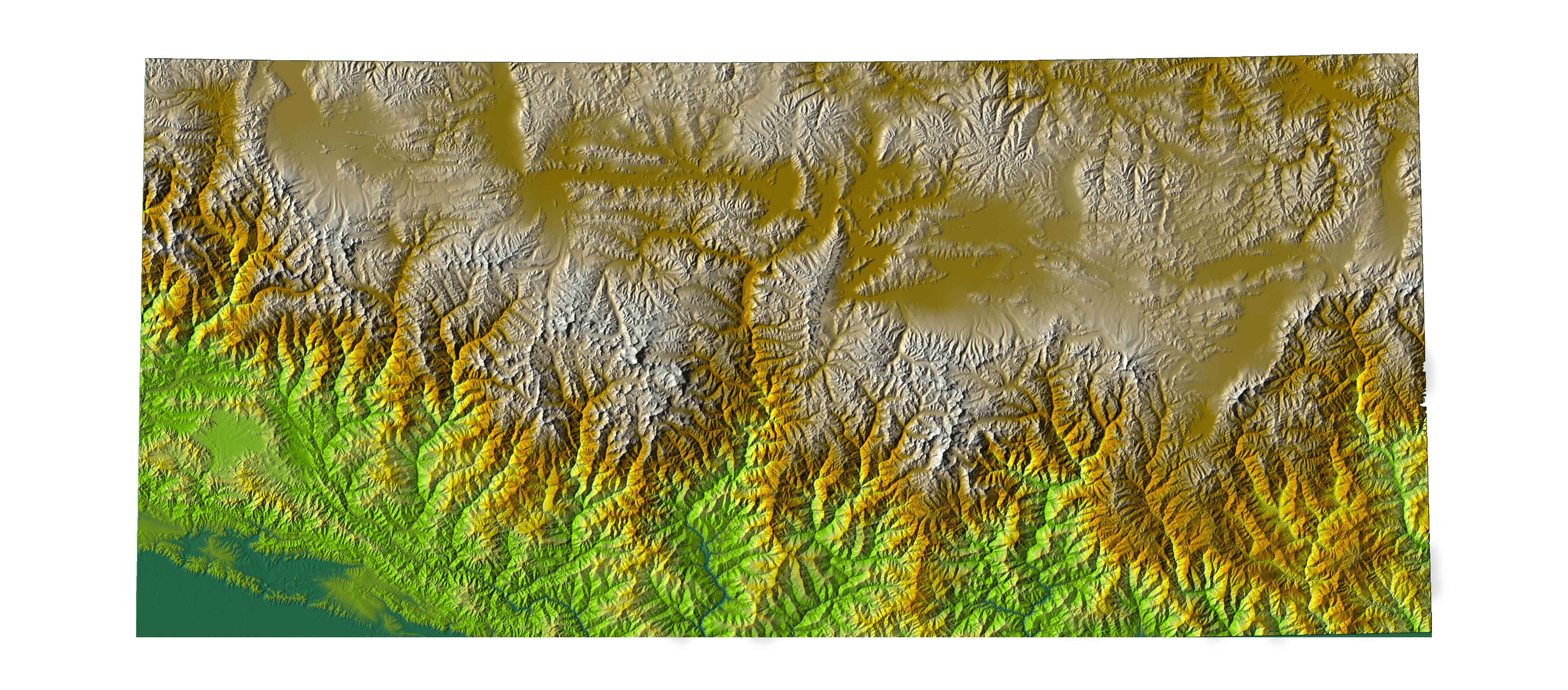

A shaded color relief image (1MB) of the Himalayas, from n28e085 to n29e089, has been created by Rafal Jonca of Poland, using 3dem to convert the data downloadable from this page to .dem files. Click here for a higher resolution version (3.75MB).
See also my virtual earth products review page.
HGT File Format
An HGT file covers an area of 1°x1°. Its south western corner can be deduced from its file name: for example, n51e002.hgt covers the area between N 51° E 2° and N 52° E 3°, and s14w077.hgt covers S 14° W 77° to S 13° W 76°. The fils size depends on the resolution. If this is 1", there are 3601 rows of 3601 cells each; if it is 3", there are 1201 rows of 1201 cells each. The rows are laid out like text on a page, starting with the northernmost row, with each row reading from west to east. Each cell has two bytes, and the elevation at that cell is 256*(1st byte) + (2nd byte). It follows that a 3" HGT file has a file length of 2 x 1201 x 1201. SRTM 3" cells are calculated by calculating the mean of 1" cells and their eight neighbors. It follows that the highest local point is likely to higher than the highest SRTM 3" cell. The difference should vary with the steepness of the local relief.